


An American Hunger for a Merciful Afterlife
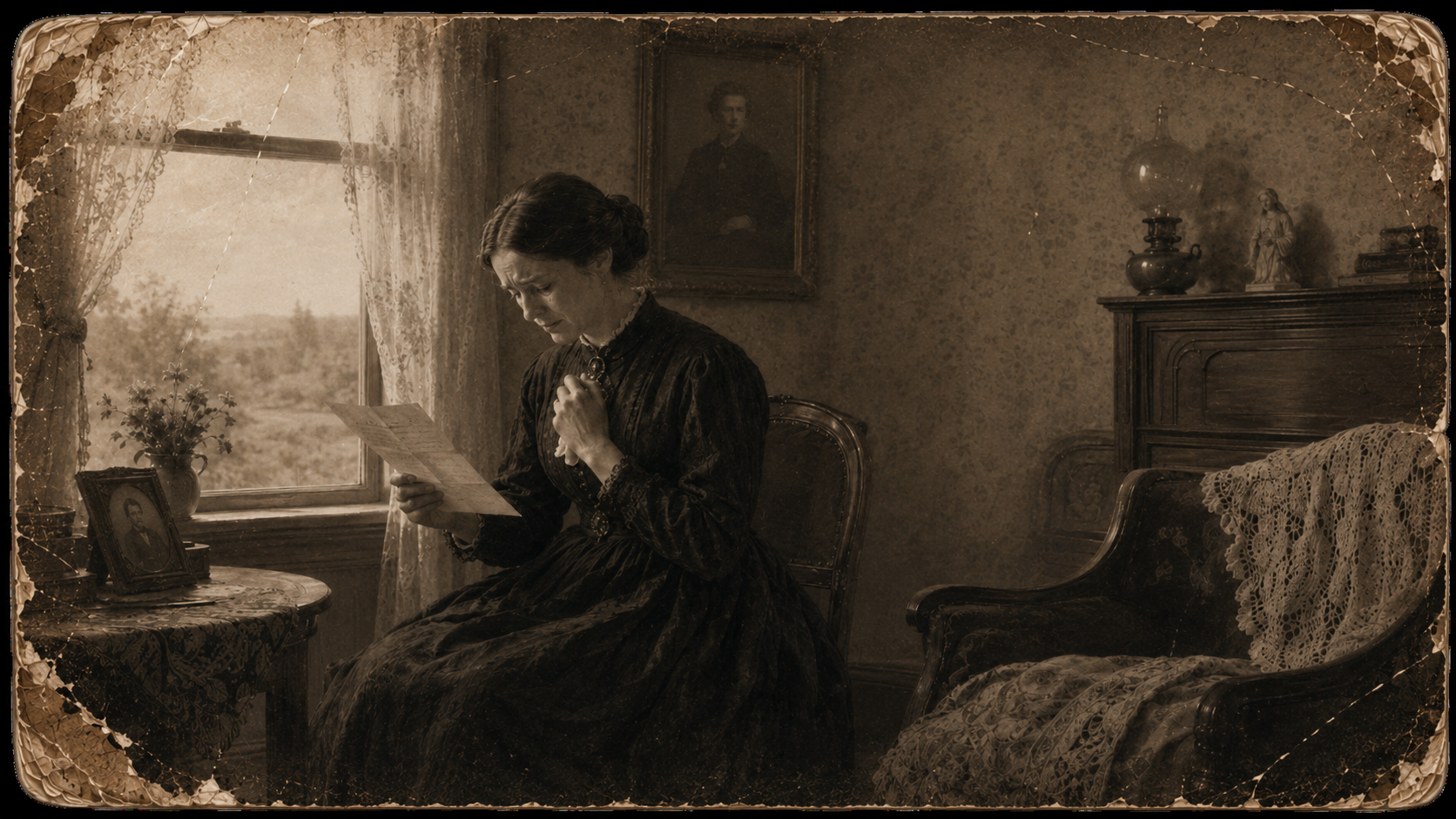
There is an interesting relationship between Spiritualism, death, and the American Civil War. The war forced a new kind of relationship to death, whereas one might imagine a prior ideal, the "good death": a bedside, a body, a grave, a minister standing by. Now there is just a message carried home by another soldier. There is far less closure, no last words, probably not even a body, just a word carried: "he's gone."
Of course, a preoccupation with the afterlife was nothing new. The older Protestant world had never treated death as merely a biological event. Death was theological. It belonged to the drama of salvation, judgment, providence, heaven, and hell. The dying person was not only leaving the household. He or she was approaching eternity. But the Civil War changed the grammar around death.
That is why the manner of dying mattered so much. The "good death" was not simply peaceful. It was legible. It allowed the family to read death spiritually. Last words mattered because they offered evidence. A calm face, a prayer, a blessing, a final assurance of faith, all these helped the living believe that the soul had passed safely into God's keeping.
The older religious imagination carried real severity. Hell was not a metaphor in much of American Christianity. Judgment was, for most believers, a very real potential waiting beyond death. This of course shaped everything in the present: how they lived, what they feared, what they hoped for, and how they understood the moral meaning of ordinary life.
And yet, through the nineteenth century, something was changing. Heaven did not cease to be theological, but it became more domestic. It was increasingly imagined not only as glory, worship, or reward, but as reunion. The dead would know one another. Parents would find children. Husbands and wives would meet again. The family circle, broken on earth, might be restored in eternity.
This was not a simple decline from stern doctrine into sentimentality. That would be too crude. Hell did not vanish. Judgment did not disappear. Conservative churches retained the older terrors, and many Americans still believed that eternity involved terrible moral stakes. But alongside these older ideas there grew a warmer heaven, a more intimate heaven, a heaven with faces in it.
The afterlife became, increasingly, a home.
This shift prepared the ground for Spiritualism. Spiritualism did not invent the longing for reunion. It radicalized it. It took the hope of meeting the dead later and made a more startling claim: the dead might be reachable now.
Modern American Spiritualism emerged before the Civil War. The Fox sisters' Hydesville rappings belong to 1848, and Andrew Jackson Davis had already published 'The Principles of Nature' in 1847.
What Spiritualism offered was not merely comfort. It offered contact. Its central claim was that the dead had not dissolved into abstraction. They remained themselves, remained social, remained capable of relation. They could communicate through raps, a quick knock, trance speech, automatic writing, mediums, seances, letters, and print. The dead were not silent. The border between worlds had become, at least to some, porous.

This is why Spiritualism should not be reduced to grief therapy. It was grief, certainly. But it was also media, evidence, experiment, reform, performance, and theology. Molly McGarry notes that nineteenth-century Spiritualism presented itself as a kind of experimental religion, offering "scientific" evidence of immortality and a language for testing the unseen boundary between this world and the next. It grew in the same world as the telegraph, photography, mass print, and new habits of communication. To speak across wires already seemed uncanny. To freeze an image on a plate already seemed like a small victory over time. Why, then, should the dead be absolutely unreachable?
Obviously, the question is not whether the Spiritualists were right. It is why their claims became plausible, consoling, and imaginatively powerful in their own world.
They described an afterlife that was neither remote nor cruelly fixed. The dead remained recognizable. They inhabited a social world. They continued to grow. Moral consequence remained, but damnation no longer had to be everlasting stasis. In Spiritualist thought, the next world often appeared as a realm of education, repair, and development, a place where the soul's story continued rather than ended in a single irreversible verdict.
The Civil War did not create this hunger. It stripped away the ordinary protections by which Americans had tried to face death.
Death had always belonged to Protestant life, but the war changed its scale and texture. Roughly three million men served in a country of about thirty-one million, and hundreds of thousands died. Many died far from home, in camps, hospitals, prisons, fields, woods, and makeshift burial grounds. Families were often denied the body, the grave, the minister, and the last words by which death had traditionally been made legible.
The old culture of dying needed witnesses. The war scattered death beyond the household.
Letters became a form of repair. Soldiers wrote before battle. Nurses, chaplains, officers, and comrades wrote afterward. A letter might report a final prayer, a calm expression, a brave word, a remembered wife, a mother's name. It might assure the living that the dead had not been alone, afraid, or spiritually unprepared. But it remained a substitute deathbed. It could soften absence, not undo it.
Spiritualism gained force in that breach. It did not offer a new answer to a new question. It offered an answer already available before the war, now sharpened by mass bereavement.
The bereaved did not want immortality in general. They wanted the particular dead. They wanted to know whether this son suffered, whether this husband remembered them, whether this child was still herself. Christianity could speak of resurrection, heaven, judgment, and hope. Spiritualism made the more immediate claim: the dead could answer.
That claim mattered where ordinary mourning had failed. A missing body did not end relation. A lost deathbed did not mean lost last words. An unknown grave did not hold the dead in silence. Where Christian consolation often asked the mourner to trust, Spiritualism offered what believers took to be contact.

This did not make it respectable. Spiritualism was mocked, exposed, defended, commercialized, and believed. It drew frauds and mourners, reformers and eccentrics, bereaved parents and public lecturers. Its instability was part of its cultural power. It belonged to a world in which religious authority was contested, scientific confidence was rising, and new media had already made distance feel less absolute.
Andrew Jackson Davis was not the center of the Civil War story, but he shows the kind of afterlife many Americans were becoming able to imagine. In 'Death and the After-Life' and related writings, Davis presented the Summer Land not as an eternal courtroom, but as a structured world of continued existence. It had society, labor, instruction, relation, and progress. The afterlife was no longer only verdict. It was a country.
That vision was merciful without becoming vague. Davis did not erase consequence. He placed it within a larger process of moral growth. The universe remained ordered, but order did not require everlasting cruelty.
Here is the deeper movement. Nineteenth-century Americans wanted an afterlife capacious enough to preserve justice without destroying mercy, identity without freezing the soul, and love without pretending death was harmless. They wanted the dead to belong to eternity without ceasing to belong to them.
The final question is not whether the Spiritualists were right or wrong. It is what their claims answered. Spiritualism gave religious form to a longing that the Civil War made impossible to ignore. Death had come near. Heaven had to come nearer too.
📚 Bibliography
- Molly McGarry, Ghosts of Futures Past: Spiritualism and the Cultural Politics of Nineteenth-Century America (Berkeley: University of California Press, 2008).
- Drew Gilpin Faust, This Republic of Suffering: Death and the American Civil War (New York: Alfred A. Knopf, 2008). See also Mark S. Schantz, Awaiting the Heavenly Country: The Civil War and America's Culture of Death (Ithaca: Cornell University Press, 2008).
- Faust, This Republic of Suffering, especially the discussion of the "good death," death letters, and the struggle to recover last words, bodies, and graves.
- Andrew Jackson Davis, Death and the After-Life: Eight Evening Lectures on the Summer-Land (Boston: William White and Company, 1871). See also Davis, A Stellar Key to the Summer Land (Boston: William White and Company, 1868).
