


The Philosophical Foundations of the Trivium
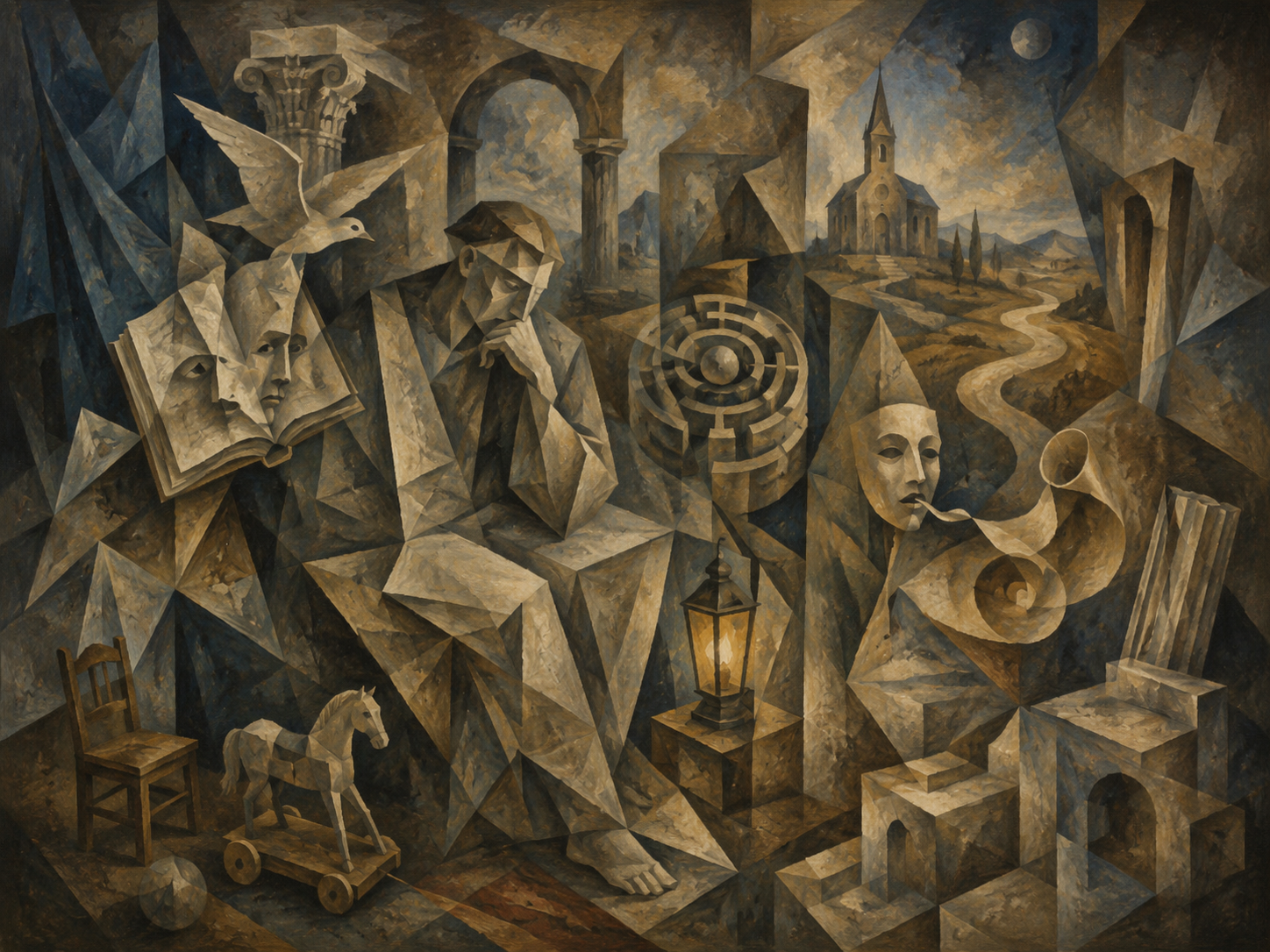
There are some underlying assumptions behind the Trivium as presented by Sister Miriam Joseph that sit uneasily with me, so in this essay I am going to think through the issues out loud.
By the Trivium, I mean the three lower liberal arts of the classical tradition: grammar, logic, and rhetoric. In Sister Miriam Joseph's account, these are not merely school subjects. Grammar teaches the structure of language, logic teaches the structure of valid thought, and rhetoric teaches the art of persuasive and beautiful expression. Together, they form a kind of intellectual apprenticeship: a way of training the mind to receive, order, judge, and communicate reality.
But this is where the difficulty begins. The Trivium, at least in its classical Christian form, is not metaphysically neutral. It assumes that language, reason, and reality belong together. It assumes that the mind is not merely arranging impressions, inventing meanings, or playing within inherited vocabularies, but being educated into truth. That is why a discussion of Sister Miriam Joseph so quickly becomes, for me, a discussion of philosophy and theology. Her educational vision rests upon a larger Christian and classical confidence: that the world is intelligible because it is created, and that reason can know it because reason participates in that order.
Sister Miriam Joseph was a 20th-century American Catholic nun writing from within the classical Catholic, Aristotelian-Thomist tradition. Her work assumes a realist metaphysics: that reason can truly know reality, that nature is intelligible, and that language and logic are ultimately ordered toward truth. There is something comforting in this framing, something enticing, something within me that longs for such untroubled confidence. Especially with children, I feel the pull of what might be called a performative assent to realism: the desire to offer the world as meaningful, ordered, and knowable, while knowing that, intellectually, I cannot quite inhabit that confidence without qualification.

This is not an abstract discomfort for me. I trained as an Anglican priest in the early 2010s, and the theological flavor of the day was John Milbank's 'Radical Orthodoxy'. I bristled against it then, as I do now. Radical Orthodoxy is an attempt to challenge secular modernity by "re-injecting the modern world with theology," arguing that any account of reality which brackets out God is already distorted, diminished, or nihilistic. It seeks to recover an older Christian vision of the world, shaped especially by Augustine, Aquinas, liturgy, participation, and the idea that all created things receive their being from God.
The problem is that this can feel less like a recovery of truth than a decision to live inside an inherited fiction. Radical Orthodoxy knows that Kant, Nietzsche, Derrida, Foucault, and others have damaged the old confidence that reason, language, and metaphysics give us direct access to reality. Yet having absorbed their suspicion of secular modernity, it then seems to step around that suspicion when it comes to its own preferred Christian metaphysics. It all feels theatrical and evasive: a kind of solemn make-believe conducted in the language of intellectual seriousness.
I am far more comfortable when people acknowledge upfront that they are working within a tradition, a vocabulary, a grammar of meaning through which the world may be interpreted. One might call this a language game, though the phrase needs some care. I do not mean by it something weightless, arbitrary, or merely fictional. A language game is not a private fantasy floating in a neutral void. It is bound up with a form of life. It belongs to the ordinary world of habit, gesture, institution, household, worship, childhood, memory, and practice. It is one of the ways human beings come to understand what things mean.
"To imagine a language means to imagine a form of life." - Ludwig Wittgenstein
That is why I do not think there is any shame in saying: here is a tradition, here is a vocabulary, here is a grammar of meaning. This is the world through which we have learned to speak, judge, hope, fear, praise, repent, forgive, marry, mourn, and raise children. What I find harder to accept is the attempt to smuggle that grammar back in as metaphysical certainty, as though the intervening centuries of philosophical suspicion can simply be baptized and made harmless. And I am made more uncomfortable still when those who half-know the provisional character of their own inheritance draw in others who do not know, or cannot know, the difference between inhabiting a tradition and mistaking it for the structure of reality itself.

But this does not lead me to a simple liberalism of dissolution. If anything, the provisional nature of our inherited meanings makes me more cautious, not less. Because our meanings are inherited, fragile, embodied, and socially enacted, we should be cautious about casually dissolving the forms of life that carry them. A tradition may not be metaphysically certain, but it is not therefore nothing. It may not be guaranteed by the structure of reality itself, but it may still carry wisdom that cannot be easily reconstructed once lost.
To acknowledge that inherited forms are historically contingent is not to prove that they are arbitrary. Nor does it mean they can be endlessly revised without cost. This is where I find myself more conservative than some of my own premises might suggest. I cannot honestly claim that inherited forms descend to us with divine or metaphysical certainty. But I also cannot accept the modern habit of treating them as though they were merely oppressive scripts awaiting liberation. There are forms by which human beings learn fidelity, restraint, reverence, obligation, and seriousness. The fact that these forms are inherited does not make them holy. But neither does it make them disposable.
Inherited forms deserve neither automatic obedience nor casual destruction. Some deserve criticism. Some deserve reform. Some deserve abandonment. But this judgment should be made with seriousness, not with the thin arrogance of people who imagine that because a form is contingent, it is therefore meaningless. There is a kind of conservatism that begins not with certainty, but with humility: the recognition that we do not fully understand what our inherited practices are doing until we have already damaged them.
This seems especially important in education. Children do not enter the world as free-floating critics of meaning. They are inducted into a world before they are capable of judging it. Language comes before critique. Family comes before theory. Habit comes before self-conscious choice. A child is always formed by some grammar of meaning, whether that grammar is acknowledged or not.
"Of what story or stories do I find myself a part?" - Alasdair MacIntyre
That induction can be abused, of course. It can become coercion, narrowness, or falsehood. But the answer cannot be to raise children in some imagined neutral space, because no such space exists. The real question is not whether a child will be formed, but by what. Is the world into which she is being invited worthy, beautiful, truthful enough, and capable of later self-criticism? Can it give her roots without making those roots into chains? Can it teach reverence without making reverence stupid?
So the question becomes: if I cannot accept the metaphysical confidence beneath the classical Trivium, what, if anything, remains worth preserving? I do not think the answer can be a simple return to Sister Miriam Joseph's world. I cannot pretend that language transparently carries us to truth, or that logic simply discloses the rational order of creation. But neither do I want to discard the Trivium as useless because its older metaphysical foundations no longer hold for me. Perhaps its value lies elsewhere: not in guaranteeing that the world is ordered, but in training the mind to attend, to distinguish, to reason, and to speak with care.
In practice, this would mean treating grammar, logic, and rhetoric not as stages in the child's ascent toward metaphysical certainty, but as disciplines of attention within an inherited world whose meanings are real, powerful, provisional, and vulnerable.
Grammar would teach the child that words matter, that sentences shape thought, and that language is never merely a transparent pane of glass through which reality appears. It would also teach that one does not invent speech from nothing. One receives a language before one uses it. To speak well is not simply to express oneself, but to enter an inheritance.
Logic would teach her to ask what follows, what does not follow, what has been proved, and what is only an atmosphere pretending to be an argument. But it would also teach a certain restraint. Not every feeling is an insight. Not every act of suspicion is wisdom. Not every inherited thing becomes false because one has learned to analyze it. Logic, properly taught, should not merely train a child to dismantle arguments. It should train her to notice when dismantling has become a reflex, when cleverness has begun to feed on reverence, and when skepticism has ceased to be a tool and become a temperament.
Rhetoric would teach her that words can clarify, enchant, wound, persuade, and deceive, and that the moral task is to know the difference. It would teach her that beauty is not the enemy of truth, but neither is it a substitute for it. It would teach her to speak with force without becoming manipulative, and to persuade without confusing victory with wisdom. In a world saturated with language, this seems no small thing.
This, then, is what remains of the Trivium for me: not the old Catholic confidence that the mind is being trained to perceive the rational order of creation, but something more provisional and more uneasy. It is a way of forming a child within an inherited world while also preparing her to understand that inheritance as inheritance. It gives her a grammar before it asks her to critique grammar. It gives her forms before it invites her to revise forms. It gives her reverence before suspicion, not because suspicion is forbidden, but because suspicion without reverence becomes thin, clever, and destructive.
I cannot give my child metaphysical certainty. I cannot honestly say: this is simply the structure of reality, and your task is only to conform yourself to it. But I can give her something less grand and perhaps more honest: a world thick with meaning, a language capable of precision and beauty, habits of thought that resist stupidity, and inherited forms treated neither as idols nor as rubbish. I can say: here is a tradition, here is a vocabulary, here is a grammar of meaning. It is not everything. It is not beyond question. But it is not nothing.
