


A Genealogy of Education Toward Freeing Souls
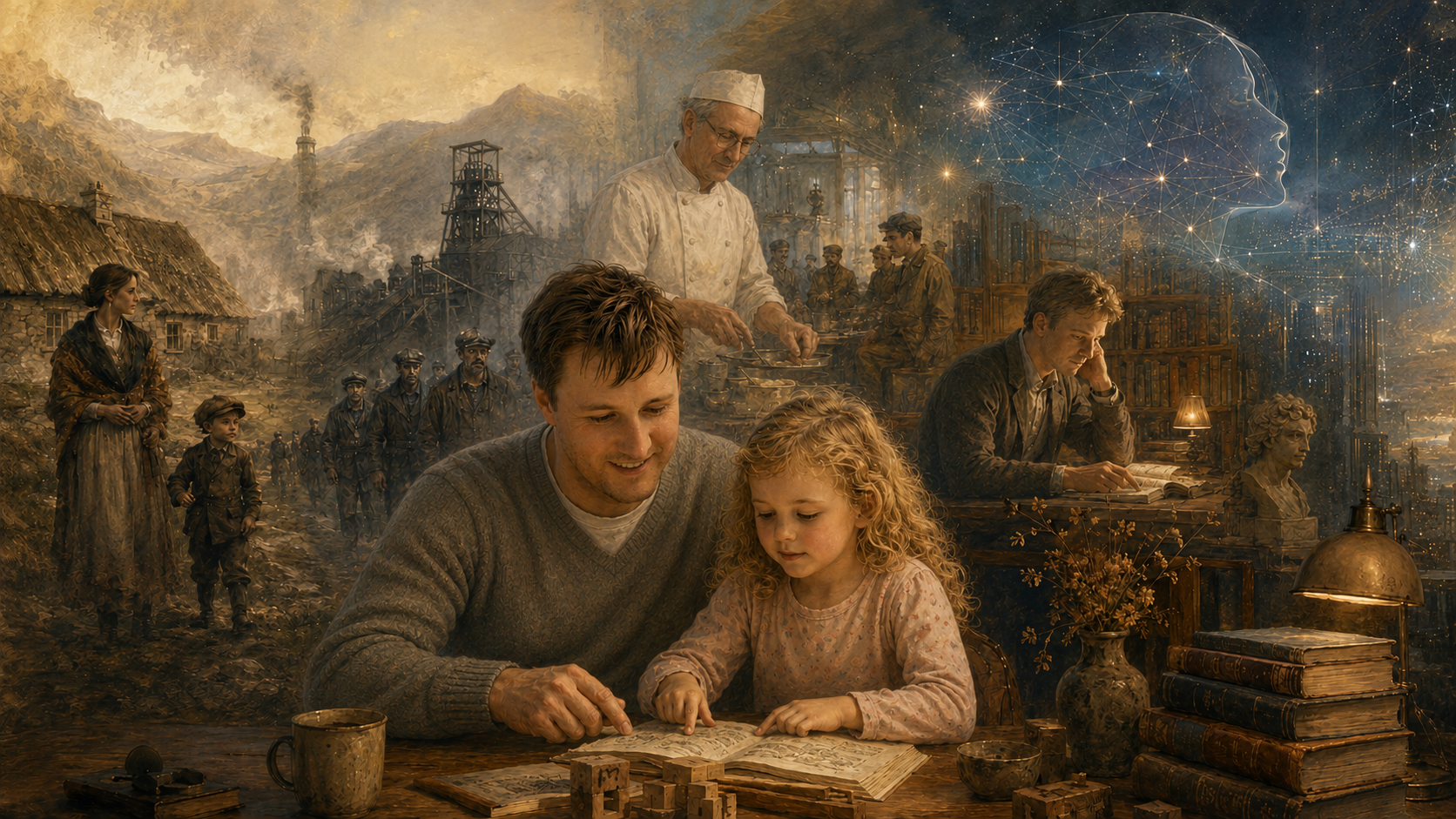
Our daughter is nearly three, and we are just reaching the stage when teaching begins to feel more deliberate. Every parent teaches from the beginning: by gesture, tone, repetition, affection, correction, and example. But there is a new kind of teaching that begins when a child can sit with you and start to grasp letters, sounds, and numbers, when you can begin to show her that the world is not only encountered, but named, ordered, and understood.
Questions about artificial intelligence, work, meaning, and the future have been recurring concerns in my writing. I have written about purpose after scarcity in 'The Post-Scarcity Vineyard', about work and meaning in 'Wage Labor and the Meaning Crisis', and about the weakening of a shared world in 'The End of Shared Reality'. These questions become less abstract when considered from the vantage of a parent. They become questions not only about the future of work, but about what kind of person one is trying to help a child become.
A Paternal Genealogy
My great-grandfather, John Connolly, was born in County Cork in 1875. His education would have been extremely limited. He might have had a few years of schooling, probably some basic reading, writing, and arithmetic, along with a good deal of Catholic religious instruction. At some point, poor prospects in Ireland led him to seek industrial work in South Wales. He became a coal miner.
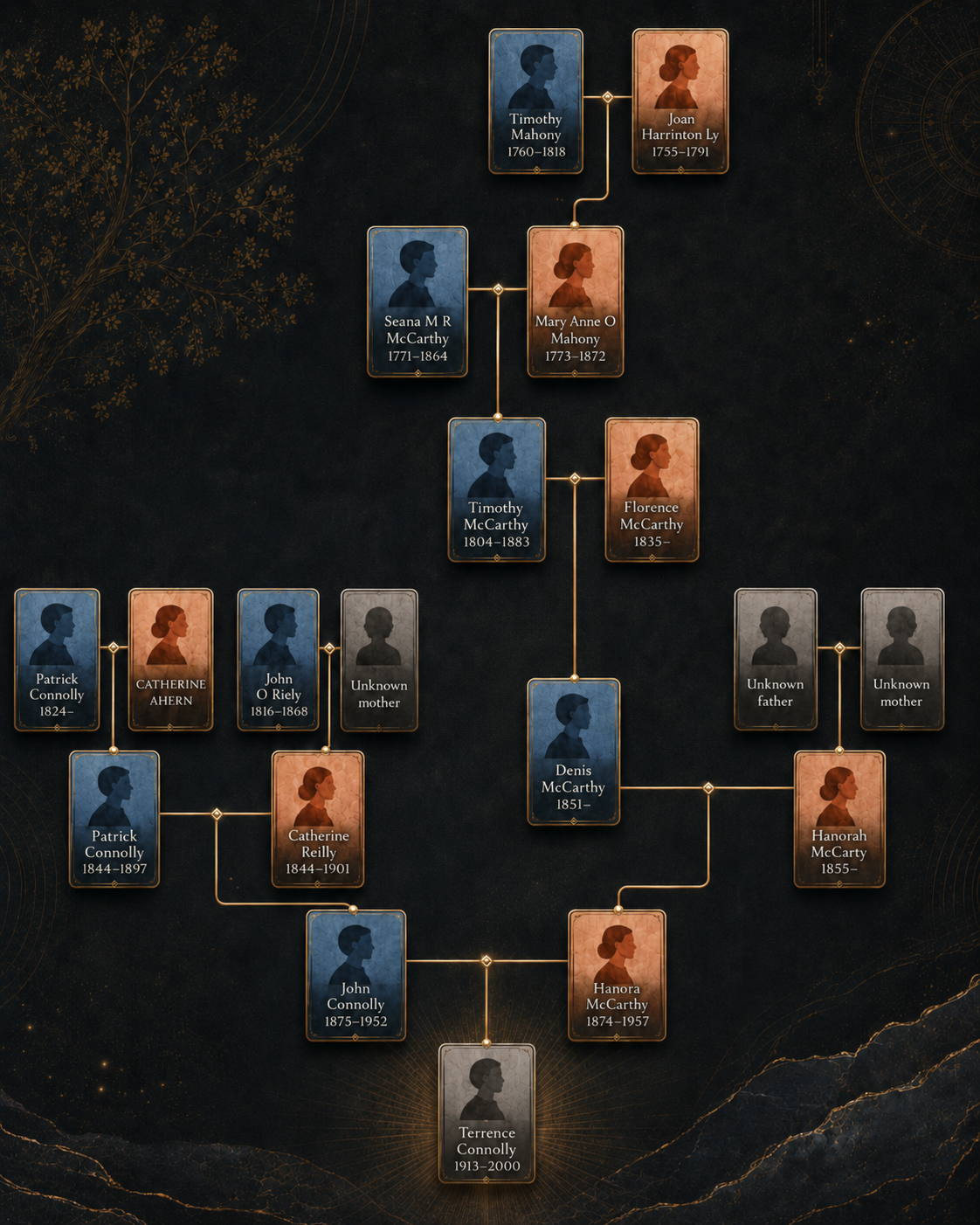
Genealogical note: A passage in Richard O’Dwyer’s 'Annals of Beara' appears to identify Nora, wife of Denny McCarthy the weaver, as the daughter of John Rahilly and Maire Ní Rohane. This likely corresponds to Hanora/Hanorah McCarthy in my family tree. The same passage preserves a vivid detail: Maire Rua later worked on the construction of the 'New Line', the road between Ardgroom and Eyeries, drawing stones in a basket on her back and receiving meals as payment.
My grandfather, Terrence Connolly, was born in South Wales in 1913. I think he probably had a basic elementary education, leaving school around the age of 12 or 14. Not wanting to follow his father down the pit, however, he ran away from home and never looked back. He joined the Army, trained as a cook, served in World War II, and ultimately became a chef in a hotel in Eastbourne, East Sussex.
My father, Patrick Connolly, was born in Eastbourne in 1956. Toward the end of his primary school education, he took what was called the 11-plus, an exam used to determine the kind of secondary school a child would attend. Children who did well, as my father did, won a place at a grammar school, which offered a more academic education. He went on to study physics at the University of Birmingham, joined the oil industry, and lived in various places. By the late 1980s, he was working in Glasgow, Scotland.
I was born in Glasgow in 1988. I am not going to go through my entire educational history again. It is covered on the About Me page, and I discussed some of it in my previous article 'ADHD: Three Months After Diagnosis'. But I hold several degrees, including postgraduate qualifications in theology and psychology, fields that belong broadly to the liberal arts: forms of study concerned less with technical utility than with meaning, interpretation, and the formation of the human person. Like the generations before me, I have also moved more than once, and have ended up in the United States, in Charlotte, North Carolina. My first daughter was born in Charlotte in 2023.
School as Social Formation
In the wake of industrialization, education increasingly became a technology of social formation. It taught literacy and numeracy, but it also trained habits of compliance: punctuality, obedience, task completion, deference to authority, and submission to external measurement. The hidden curriculum of the classroom was often more powerful than the official one. Bells divided time. Examinations ranked ability. Timetables broke attention into manageable units. Children learned to wait, to ask permission, to suppress their own questions, and to complete work whose purpose they had not chosen. The governing question became, "How might this person become useful?"
That question is now collapsing. If AI continues on its present course, human usefulness in the old economic sense is finished. The machine will write, calculate, design, manage, advise, and produce. It will do the useful things. If education is only preparation for usefulness, then education has lost its governing purpose.

Recently I have been reading Sister Miriam Joseph's 'The Trivium: The Liberal Arts of Logic, Grammar, and Rhetoric'. Early in the book, she draws a distinction that feels especially important now. The liberal arts are not primarily useful in the ordinary economic sense. They are not like carpentry, banking, law, medicine, or any other art by which one produces something external and earns a living. Their work happens within the person. They train the faculties. They deepen perception. They order thought.
This is the sense in which a liberal education is ordered toward freedom. It makes a person free by forming the powers by which he can know, judge, speak, and act. The classic trivium of grammar, logic, and rhetoric is therefore not a set of decorative subjects from a lost world. It is a discipline of awakening: the arts by which the mind becomes capable of truth, and by which a child begins to rise above mere usefulness into a fuller life of imagination, judgment, connection, inward abundance, and the apprehension of the good and the beautiful.
"Art for art's sake is an empty phrase. Art for the sake of truth, art for the sake of the good and the beautiful, that is the faith I am searching for." - George Sand
The Trivium After Usefulness
Seen across these generations, education appears first as survival, then as escape, then as mobility, and finally, in my own case, as something less directly tied to economic necessity. Each form belonged to its own circumstances. But the pattern reveals how often education has been understood in relation to usefulness, advancement, and professional competence.
But what happens when usefulness is no longer the governing measure? What happens when artificial intelligence does not merely change work, but pushes us toward a world where much of what we once called productive activity has been automated, simulated, or made optional?
This is where the trivium begins to look less like an antiquated curriculum and more like a preparation for human fullness. Even in a post-scarcity world, even in a world of elaborate simulations and artificial environments, a person would still need to read the world, judge the world, and answer the world. Grammar, logic, and rhetoric would remain the arts by which a person could live more widely, more consciously, and more freely.
The point would not be usefulness in the old economic sense. It would be something closer to elevation. A person formed by the trivium would not simply consume experience. He would perceive patterns, understand symbols, test appearances, make connections, ask better questions, and speak more truthfully. This is close to John Stuart Mill's distinction between lower and higher pleasures: not all satisfactions are equal, because not all of them awaken the same powers of the soul.

For my daughter, this would not mean an antiquarian education, as if we were cosplaying the Middle Ages. A new trivium would begin very simply: with stories, songs, names, poems, numbers, and the slow acquisition of words.
Grammar would mean more than correctness. It would mean helping her learn the structure of the world as it comes to her through language: the names of things, the order of stories, the difference between one thing and another, and the inherited symbols by which human beings make meaning. It would mean reading aloud, learning family history, noticing patterns, asking what words mean, and coming to see that reality is not a blur of impressions but something that can be received, named, and loved.
Logic would come later, though its beginnings are already present whenever a child asks why. It would mean teaching her not only to gather information, but to test it. What follows from this? Does this contradict that? Is this true, or only attractive? In a world of artificial companions, generated images, persuasive systems, and simulated possibilities, logic would be a form of inward self-defense. It would help her distinguish appearance from reality, desire from truth, and freedom from manipulation. The point would not be to make her coldly analytical, but to give her a mind that can remain awake.
Rhetoric would be the art by which she learns to answer the world. She would learn to tell a story clearly, to explain what she means, to ask for what she needs, to apologize, to refuse, to praise, to comfort, and to persuade without manipulation. In an age when machines will generate endless language, the human task will not be merely to produce more words. It will be to speak truthfully from a formed interior life. A child educated in rhetoric would not simply have access to expression. She would have a voice.
The deeper purpose of such an education would be to enlarge the range of my daughter's possible life. If she someday inhabits worlds stranger and more elaborate than we can know, even worlds partly artificial or simulated, these arts would still matter. She would still need to read the signs of those worlds, judge their claims upon her, and answer them from the center of herself.
This is why the trivium feels newly relevant rather than obsolete. A post-scarcity world may offer endless pleasure, novelty, and escape. But not all pleasures awaken the same powers. Some merely soothe us; others enlarge us. A liberal education trains the higher pleasures: understanding, contemplation, friendship, beauty, judgment, truth, and the imaginative apprehension of possibility. It teaches the soul how to remain awake.
