


The Monument That Changed
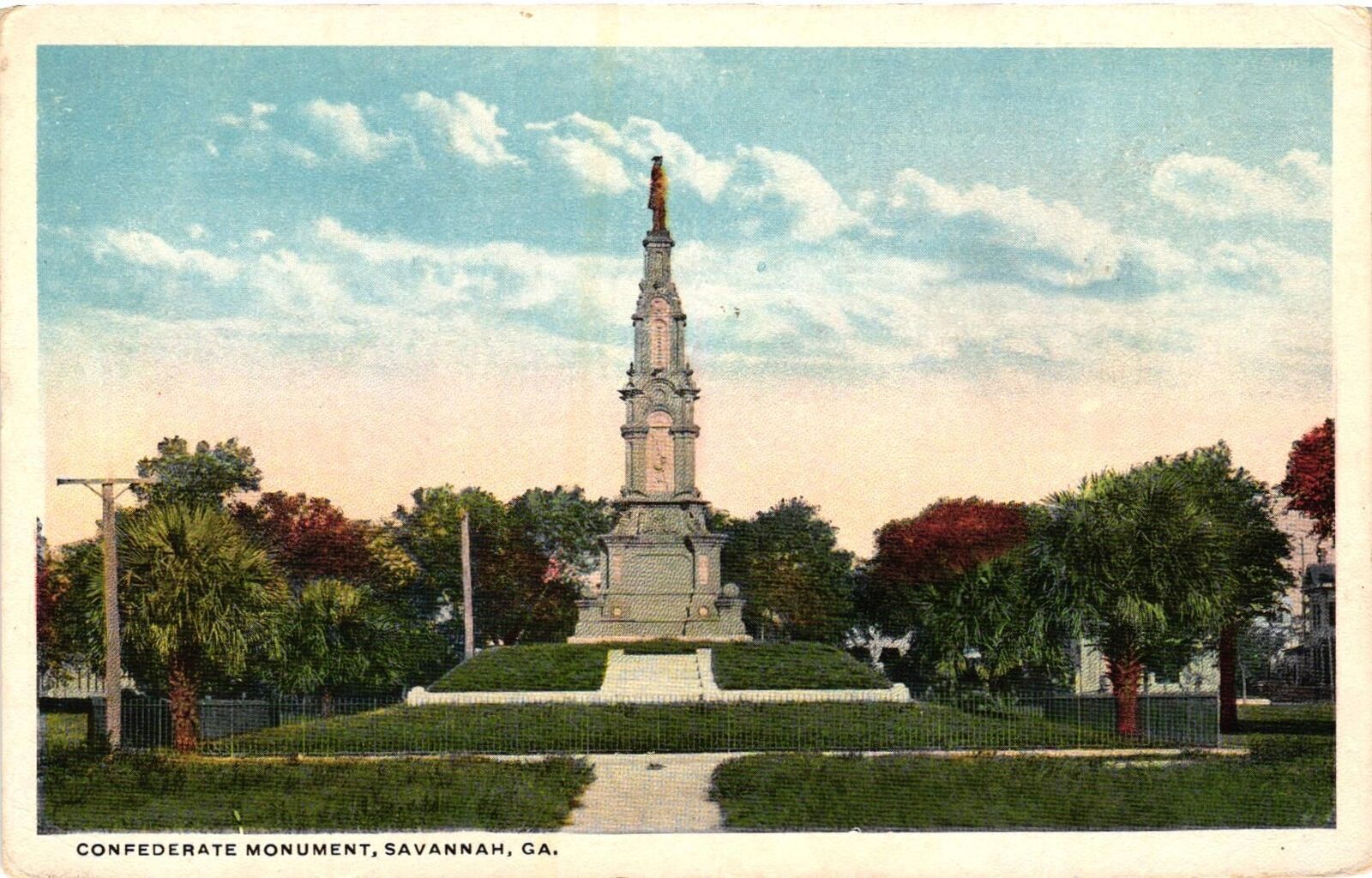
The monument stands in Forsyth Park as if it has always been itself. This is the first illusion. A bronze soldier looks out from the top of the shaft, enclosed by fence and path and the ordinary movement of Savannah life. People walk past it, photograph it, argue about it, ignore it. The monument does what monuments are supposed to do: it appears still.
And yet almost nothing about it has stayed still. Its body has been altered, simplified, renamed, defended, reconsidered. Its statues have been removed and sent elsewhere. Its fence has changed shape. Its meaning has been scraped and rewritten so many times that the object now feels less like a single monument than a biography in stone. It is not only a Confederate memorial. It is a public object repeatedly revised, one of those strange civic things in which a city keeps trying to amend itself without quite being able to erase the earlier writing.
There is an old word for this: palimpsest. Originally, it meant a reused page, scraped clean so that new words could be written over it, though the earlier marks often remained faintly visible. The Forsyth Park monument works in just this way, except the page is sandstone, bronze, iron, public space, and civic unease. Each generation has looked at the same object and found it inadequate in a different way. Too abstract. Too anonymous. Too Confederate. Too public. Too difficult to move. Too useful to leave alone.

The first version, dedicated on May 24, 1875, was not the soldier we now know. It was a high Victorian structure designed by Robert Reid of Montreal, built from Nova Scotia sandstone, and filled with a language of carved meaning: swords, drums, flags, inverted torches, garlands, wreaths, cherubs, urns, finials, and a mourning female figure framed by weeping willows. Even its Canadian origin carried meaning. Feelings toward the North remained strong enough that the monument was designed, quarried, worked, and shipped in such a way that it would not have to pass over Yankee soil. The Ladies Memorial Association had raised the money through fairs, concerts, bake sales, and subscriptions. The first layer of this memorial was not municipal in the cold sense. It was organized, argued for, and paid for by women doing the work of memory in a defeated city.
But the object they brought into being was odd. At the center of the design were two marble women, Silence and Judgment. Silence stood under an open canopy, one finger to her lips, holding an inverted torch. She suggested that the desolation of war had passed into quiet remembrance. Judgment stood above her, trumpet and scroll in hand, summoning the universe to attend to the justice of the Confederate cause. The monument did not simply mourn the dead. It tried to place them within a cosmic court, as if history itself might yet reverse the verdict.
This was a great deal for one monument to carry. Perhaps too much. Savannah, a city not exactly free from theatrical instinct, nevertheless seems to have found the thing overburdened. The ornaments were dismissed as lacking charm, even tacky. That word is useful because it punctures the solemnity. We are accustomed to thinking of monuments as grave, immovable, almost beyond taste. But here taste entered the argument. The city looked at the stone cherubs and allegorical women and found, in some sense, a failure of style. The monument had attempted profundity and produced embarrassment.
So in 1879 it was rewritten. George Wymberly Jones De Renne funded the change, and the marble women were removed. Judgment was sent to the soldiers' circle in Thomasville. Silence went to Laurel Grove, to watch over the Gettysburg dead. They were not destroyed. They became afterimages, fragments of the first text preserved elsewhere, as if the monument could not quite bear to lose its original dream.
In their place came the bronze soldier by David Richards, the figure that now defines the site. He is an Everyman, a common soldier, standing at parade rest. De Renne wanted the memorial to turn from abstract vindication toward the men without name or fame, those who had borne the human cost of the war. Even the pose carries tension. Parade rest suggests submission to the inevitable, but not collapse. The soldier is still upright. His hat is thrown back so that the wind might cool his heated head. It is a small detail, almost tender, and because it is physical rather than allegorical it does more work than the trumpet and scroll ever could.
This is the first great lesson of the monument: the literal can become stranger than the symbolic. Silence and Judgment announced their meanings too loudly. The soldier, by contrast, simply stands there, and because he stands there the city has had to keep deciding what kind of standing this is. Is it mourning? Defiance? Defeat? Nostalgia? Human pity? Confederate memory? Public grief caught in bronze? The figure does not answer. He remains available, and therefore unsettled.
The 1879 revision also left one of the monument's most interesting absences. The canopy was enclosed with stone panels, three carved with flags and one left blank. A blank panel on a monument is never only blank. It is a pause, an omission, a refusal, or an invitation. It suggests that public memory is not finished with itself, even when it pretends to be. The empty stone waits, and in waiting becomes one of the truest parts of the whole structure.
Then came 1910, and another layer was written over the earlier one. The busts of Lafayette McLaws and Francis S. Bartow were moved to the site, shifting the emphasis from the anonymous dead to named military figures. This was not a neutral addition. It changed the grammar of the place. The monument had been revised in 1879 toward the common soldier, toward those without fame. The 1910 alteration pulled it back toward personality, rank, and public honor. Even the fence had to adapt, transformed from a square enclosure into an elliptical one, as if memory itself had to be bent around the new arrivals.
There is something almost comic in this, though not light. A monument to the dead becomes a monument to an Everyman, then is made to share its ground with particular men. The park becomes a kind of argument in iron. The fence does not merely contain the memorial; it records a change in emphasis. Space, here, is thought made visible.
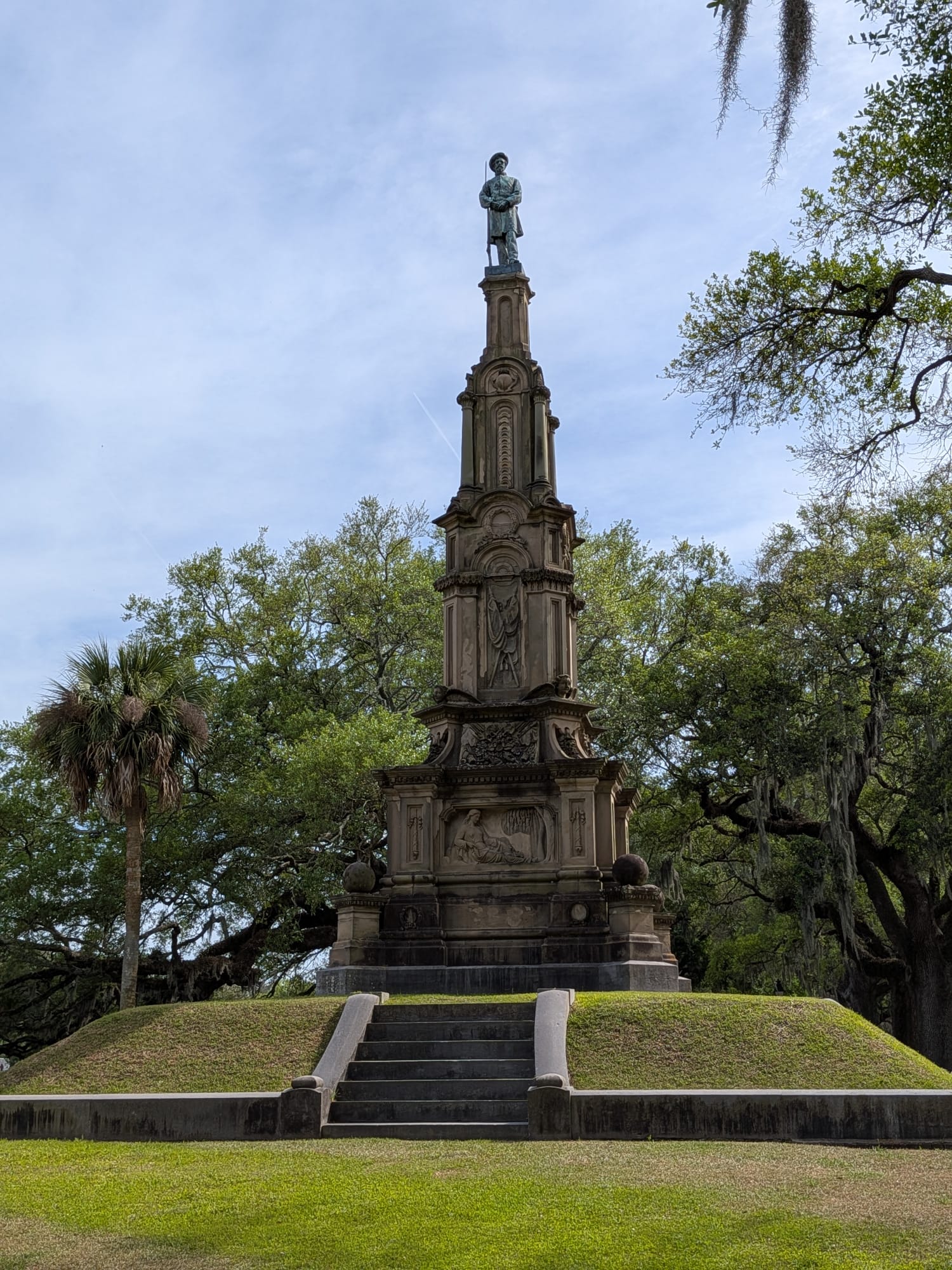
This is why the Forsyth Park monument is more interesting than a simple argument over removal or preservation allows. It has already been removed and preserved, again and again, in pieces. It has already suffered revision. Its present form is not original purity but accumulated compromise. The object itself disproves the fantasy that monuments are stable historical facts. They are choices. They are edits. They are public sentences written in stone and then revised by weather, politics, taste, grief, and later unease.
The 2017 and 2018 reconsideration of the site belongs to this longer biography. The proposal to rename it the Civil War Memorial, move the McLaws and Bartow busts to Laurel Grove North Cemetery, and add a new bronze plaque was not an interruption of the monument's history, but another chapter in it. In one sense, it even returned the site toward De Renne's 1879 revision: away from named commanders and back toward the dead.

That does not settle the monument. Perhaps nothing should. Its interest lies in the fact that it has failed to remain itself. Savannah has often preferred easier ghosts, the kind that can be sold by lamplight, but this is a more demanding haunting: Judgment removed to another town, Silence watching over another cemetery, a blank panel still waiting, and a soldier whose meaning will not settle.
Stone gives the impression of finality, but the Forsyth Park memorial shows that public memory is never final. It gathers, hardens, cracks, and is worked upon again. A city reveals itself not only in what it builds, but in what it later moves, renames, revises, or leaves blank. The monument stands still, yes. But beneath that stillness, the writing continues.
📚 Bibliography
- Confederate Memorial Task Force. Final Report. City of Savannah, December 22, 2017.
- Wheeler, Frank. "Our Confederate Dead": The Story Behind Savannah's Confederate Monument. The Georgia Historical Quarterly 82, no. 2 (Summer 1998): 382-397.
