


The Shadow Around Elizabeth Holmes
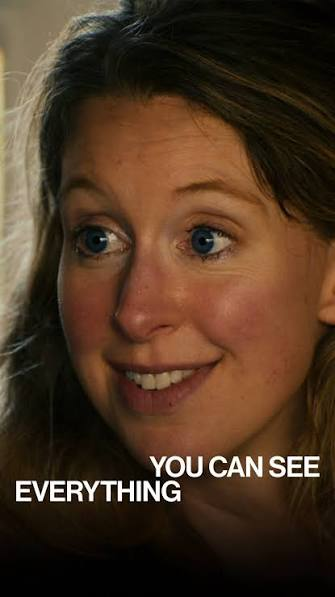
I just got back from seeing 'You Can See Everything' (2026), the new documentary about Elizabeth Holmes. I had avoided watching or reading anything about it beforehand, but knew it had provoked a great deal of discussion, and feel compelled to offer some thoughts of my own. It is an emotionally powerful and psychologically complex piece of art, and as such, very open to interpretation.
Depending on where you place the emphasis, you could come away with quite different understandings of the people involved. I found Holmes's emotional pain very affecting. There is a sense in which I understand her better, while remaining uncertain about the extent to which she is consciously manipulating those around her. Her suffering and her capacity for manipulation seem entirely capable of existing together.
Through a Jungian lens, I wonder whether we are seeing someone unable to confront her own Shadow. The Shadow comprises those aspects of ourselves that we reject or fail to recognize as belonging to us. These needn't all be morally objectionable, although aggression, dishonesty, and the desire for control might find their way there when they threaten our conscious self-image.
Holmes seems deeply attached to an understanding of herself as someone whose intentions were fundamentally good. What happens to the parts of her that cannot be accommodated within that understanding? One possibility is that they find expression through her relationships, allowing her to remain at a distance from qualities she cannot acknowledge as her own.

This is where Billy Evans becomes especially interesting. He comes across as intensely disagreeable, almost so strongly that I found myself resisting the simplicity of that reading. There is something strangely convenient about having such an obvious villain in the room. His presence makes it easier to feel protective of Elizabeth, even knowing that she was convicted of defrauding investors.
I wonder whether the men around her become, in different ways, carriers of this disowned material. They can be aggressive, controlling, and confrontational on her behalf. She can benefit from what they do while remaining identified with vulnerability and innocence. The conflict that might otherwise require an inward confrontation instead plays out between people.
This is a possible reading of the relationships presented by the film, with all the limitations that implies. It doesn't establish what Holmes knows about herself, nor does it turn the men into passive instruments. Their own desires matter. Billy may protect her from confronting herself while also finding something deeply gratifying in being the person who protects her.
There is an archetypal pattern here: the protector and the person who needs protecting. I have the impression that Holmes evokes this pattern in the men within her orbit. To become the person who understands a woman whom everyone else has condemned offers its own sense of significance. Her sense of innocence and his heroism might come to depend upon one another.
Nathan Fielder seems susceptible to something of this as well. His attempts to understand her appear to draw him toward a protective position. That is part of what makes his involvement so compelling. Even skepticism may coexist with a desire to rescue. He can question her account while also becoming invested in the possibility that he sees something in her that others have missed.
And I think the audience is invited into the same arrangement. The more objectionable Billy becomes, the more readily Elizabeth can appear to be the person who needs defending. Our judgment of him may relieve us of the difficulty of holding her vulnerability and her responsibility together. We begin to distribute innocence and darkness between people, making each easier to understand.

Of course, that distribution may also be an effect of the filmmaking. We are encountering people through an edited work, and my wish to resist the obvious villain may itself be one of its intended effects. A Jungian reading shouldn't become another means of imagining that we can see everything.
Nor does unconsciousness settle the question of responsibility. Someone may knowingly deceive others while remaining ignorant of the motives that make deception necessary to their sense of themselves. Genuine pain offers no guarantee of greater self-knowledge. I wonder whether the tragedy here is that suffering might deepen the need for protection from precisely the recognition that could change things.
What stays with me is the possibility that these relationships protect everyone involved from an uncomfortable encounter with themselves. Elizabeth can remain the misunderstood innocent; the men can remain her defenders. Even the viewer can enjoy the reassurance of knowing who deserves sympathy and who deserves contempt.
The film leaves me uneasy about that reassurance. I feel that I have seen more of Holmes, but I am less certain where to place what I have seen. Perhaps that uncertainty is where the most worthwhile reflection begins.
Also, Who's on First?
I don't find Abbott and Costello funny. Their famous 'Who's on First?' routine strikes me as rather dated, and I suspect I'd find it considerably less funny if someone insisted on showing it to me and then demanded that I explain why I was laughing. There's something uncomfortable about being made to watch something another person finds hilarious, with the expectation that you should share their amusement. It's the familiar experience of someone insisting you watch a funny YouTube video, only now your reaction is being subjected to psychological examination.
Holmes claims to find the routine funny but struggles to explain why. Perhaps she genuinely doesn't understand the central joke. So what? Children laugh at 'The Simpsons' and 'Toy Story' without understanding the more sophisticated jokes intended for adults. The absurdity, the escalating frustration, the comic timing, all of these can be amusing independently of the underlying wordplay. And even when someone understands a joke perfectly well, it hardly follows that they should be able to produce a satisfactory logical account of their amusement.
What strikes me as particularly peculiar about the exchange is the almost neurodivergent quality of Nathan's questioning. There is something recognizably autistic in this insistence on taking an intuitive social experience and subjecting it to a kind of literal examination. "But why is it funny?" It is an extraordinarily Nathan Fielder way of approaching human interaction, and perhaps part of the joke is that he seems unable to recognize how strange his own behavior has become. He creates an awkward social situation, then appears to treat the resulting awkwardness as evidence that something is wrong with the person being examined.
Of course, Holmes might be playing dumb. She might understand the joke perfectly well and be deliberately concealing that understanding. I wouldn't rule it out. But neither should we rule out the considerably more ordinary possibility that she simply doesn't understand the joke, or cannot explain her amusement under interrogation. What troubles me is how readily this exchange becomes evidence of something psychologically sinister. We are so determined to discover the machinery of Holmes's deception that almost anything she does can be made to look suspicious. Perhaps the more interesting question is why Nathan, and indeed the audience, feel such a need to establish whether her amusement is genuine. At some point, the attempt to understand another person becomes so elaborate that we lose sight of just how strange our own behavior has become.
