

The Shapes Beneath Thought
Jung is often presented as if he were simply offering a symbolic glossary. The mother, the shadow, the trickster, the wise old man - a set of recurring images that happen to appear in dreams, myths, and religions across the world. That is not false, but it is weaker than what he was actually saying.
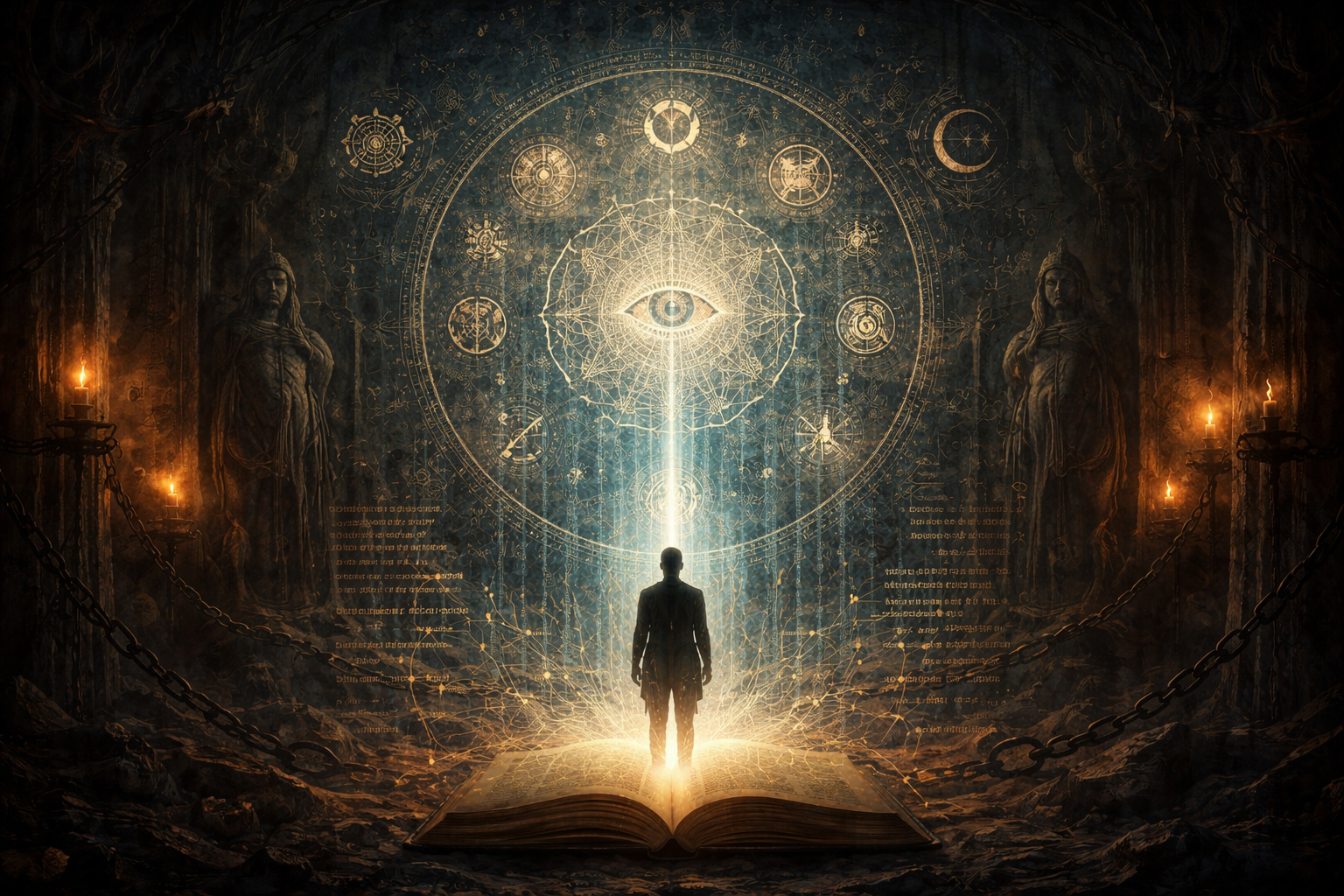
Jung’s real claim is that beneath these images there are prior forms. In “The Concept of the Collective Unconscious” he describes the collective unconscious as consisting of “pre-existent forms,” inherited structures that do not arise from personal experience. The archetype, then, is not the image itself, but the shape from which the image arises. The mother archetype is not reducible to Mary, Isis, Demeter, Gaia, or any one local expression of maternity. These are archetypal images, specific cultural manifestations. The archetype as such lies deeper down. It is not directly seen. It is inferred from recurrence.
This distinction matters, because it pushes Jung beyond mere symbolism. He is not simply saying that human beings inherit stories and keep retelling them. He is saying that mind itself is structured in advance, and that when human consciousness tries to make sense of life, it repeatedly falls into certain shapes: mother, sacrifice, descent, rebirth, shadow, king, exile, return. These are not just familiar motifs. They are recurrent forms of intelligibility. Jung’s language can be woolly at times, but on this point I think he was basically right. Meaning is not made up from scratch each time. Thought moves within contours already there.
This is why Jung remains interesting, and why the best art feels greater than the intentions of the individual artist. In Spirit in Man, Art, and Literature, Jung describes the artist at the highest level not as a private self expressing private emotions, but as a vehicle for the unconscious psychic life of mankind. This may sound grandiose, but it captures something real. There is a kind of art that feels fabricated, and there is a kind that feels uncovered. The latter seems to touch a level of form that is not merely personal. That is why it has the air of inevitability about it. It does not feel like one person making things up. It feels like something deeper finding its way into the light.
One can, of course, stop here and keep Jung in the realm of psychology. Many do. The archetypes become useful symbolic categories, a way of reading stories, dreams, personalities, and cultures. But Jung himself did not really stop there. His later work edges toward a stronger and more difficult claim. In The Structure and Dynamics of the Psyche and in his essay on synchronicity, he begins to speak of the psychoid, that point at which psyche is no longer cleanly separable from matter, and of synchronicity as an “acausal orderedness.” Whatever one makes of these terms, the movement is clear enough. Jung is no longer talking as though the mind were simply projecting significance onto a neutral world. He is moving toward the idea that mind and world may be ordered together.
This is where Jung becomes genuinely provocative. The weaker Jung is acceptable to modern people because he gives us a symbolic vocabulary without really threatening our underlying assumptions. The stronger Jung does threaten them. He raises the possibility that archetypes are not merely inherited psychological tendencies, but indications that reality itself is not as formless as we imagine. Not mythological in the childish sense, but structured. Laden with deep patterns that intelligence does not invent so much as discover.
I think that possibility deserves more seriousness than it usually gets.
The recurrence of archetypal form is too stubborn to brush aside. The same symbolic structures surface in myth, religion, dream, literature, and art not because human beings are engaged in some giant lazy act of recycling, but because there are only so many deep ways of organizing experience. The psyche returns to these forms because they are not arbitrary. They are dense packets of reality. They carry a great deal of life within them. A mother is not just a mother. She is source, dependence, safety, engulfment, nourishment, vulnerability, and origin all at once. The same is true of the king, the stranger, the trickster, the scapegoat, the shadow. These are not flimsy literary ornaments. They are compressed structures of meaning.
This is why I find the notion of archetypes as recurring compression attractors quite compelling. Whenever intelligence tries to simplify and organize reality, certain forms keep reappearing because they are unusually efficient at carrying depth. They gather enormous ranges of experience into shapes that remain graspable. That does not reduce them. Quite the opposite. It suggests that archetypes endure because they are among the most successful forms ever produced for holding together the complexity of life.

And this is where code becomes interesting.
Not because AI somehow proves Jung. It does not. Nor because one can map the collective unconscious neatly onto machine learning and be done with it. That would be too cheap. But code gives us a new field in which recurrence can be observed. For a while, it was fashionable to dismiss large language models as little more than elaborate mimicry. That line has aged badly. Recent interpretability work from Anthropic suggests that models develop internal representations, plan ahead in limited ways, and can be traced through multi-step internal processes rather than understood as mere token-by-token blurting. Whatever else these systems are doing, they are not exhausted by the phrase “stochastic parrot.”
That fact matters because it means we are no longer looking only at the symbolic output of human beings. We are looking at formal systems trained through abstraction, compression, and prediction, and finding that hidden organization emerges there too. Not consciousness, perhaps, at least not in any rich sense we can confidently defend, but structure. Latent arrangement. Internal coherence. Something more than surface imitation. The old Jungian suspicion begins to stir again: that intelligence may not create meaning ex nihilo, but repeatedly settle into certain forms when it is forced to grapple seriously with reality.
The obvious objection is that these systems are trained on human material, so naturally they reflect human symbolic habits back to us. That is fair, and it is part of the truth. But it is not the whole truth. The deeper question remains: why do these forms prove so stable in the first place? Why these shapes rather than others? Why does intelligence, again and again, reach for hierarchy, agency, sacrifice, contamination, transformation, return, shadow, mother, and double when it tries to organize experience at depth? One answer is cultural inheritance. Another is statistical efficiency. Another is cognitive inevitability. But I do not see why the stronger answer should be ruled out in advance.
Perhaps these forms recur because they are real.
Not real as objects. Not real as little mythological entities floating around somewhere in space. Real as deep structure. Real as the shapes into which intelligence naturally settles when it encounters the grain of mind and world. If that is right, then Jung’s stronger intuition begins to look less eccentric and more prophetic. The archetype would not just be an old symbolic tendency, but a point at which thought meets the underlying architecture of things. And if formal systems begin to display the same tendency toward recurrent organization, then code may turn out to be one of the clearest modern instruments yet devised for bringing those structures into view.
This is the claim, then. Archetypes are not merely recurring images in culture. They are deeper forms. They are the shapes beneath thought itself, and they reassert themselves wherever intelligence is forced to reckon with reality at sufficient depth. Myth revealed them first. Dream revealed them again. Art gave them higher expression. Now code, in its colder and less flattering way, may be revealing them too.
Jung, at his strongest, was not offering a catalogue of symbols. He was pointing toward a structured universe.
I think he saw further than we have generally allowed. Beneath image there is form, and beneath form there may be something even more difficult for modern people to admit: that mind is not simply projecting itself onto the world, but discovering patterns that were there before it arrived. If that is true, then the old archetypes are not relics of a mythic past. They are signs that intelligence, however it is instantiated, does not move randomly. It falls into form.
📚 Bibliography
-
Jung, C. G. “The Concept of the Collective Unconscious” (1936), in The Collected Works of C. G. Jung, Vol. 9, Part 1: The Archetypes and the Collective Unconscious.
-
Jung, C. G. The Archetypes and the Collective Unconscious. The Collected Works of C. G. Jung, Vol. 9, Part 1. Translated by R. F. C. Hull. Princeton: Princeton University Press, 1969.
-
Jung, C. G. Spirit in Man, Art, and Literature. The Collected Works of C. G. Jung, Vol. 15. Translated by R. F. C. Hull. Princeton: Princeton University Press, 1966.
-
Jung, C. G. The Structure and Dynamics of the Psyche. The Collected Works of C. G. Jung, Vol. 8. Translated by R. F. C. Hull. Princeton: Princeton University Press, 1960. See also “Synchronicity: An Acausal Connecting Principle.”
-
Anthropic. “Tracing the Thoughts of a Large Language Model.” March 2025.
