


The End of Shared Reality
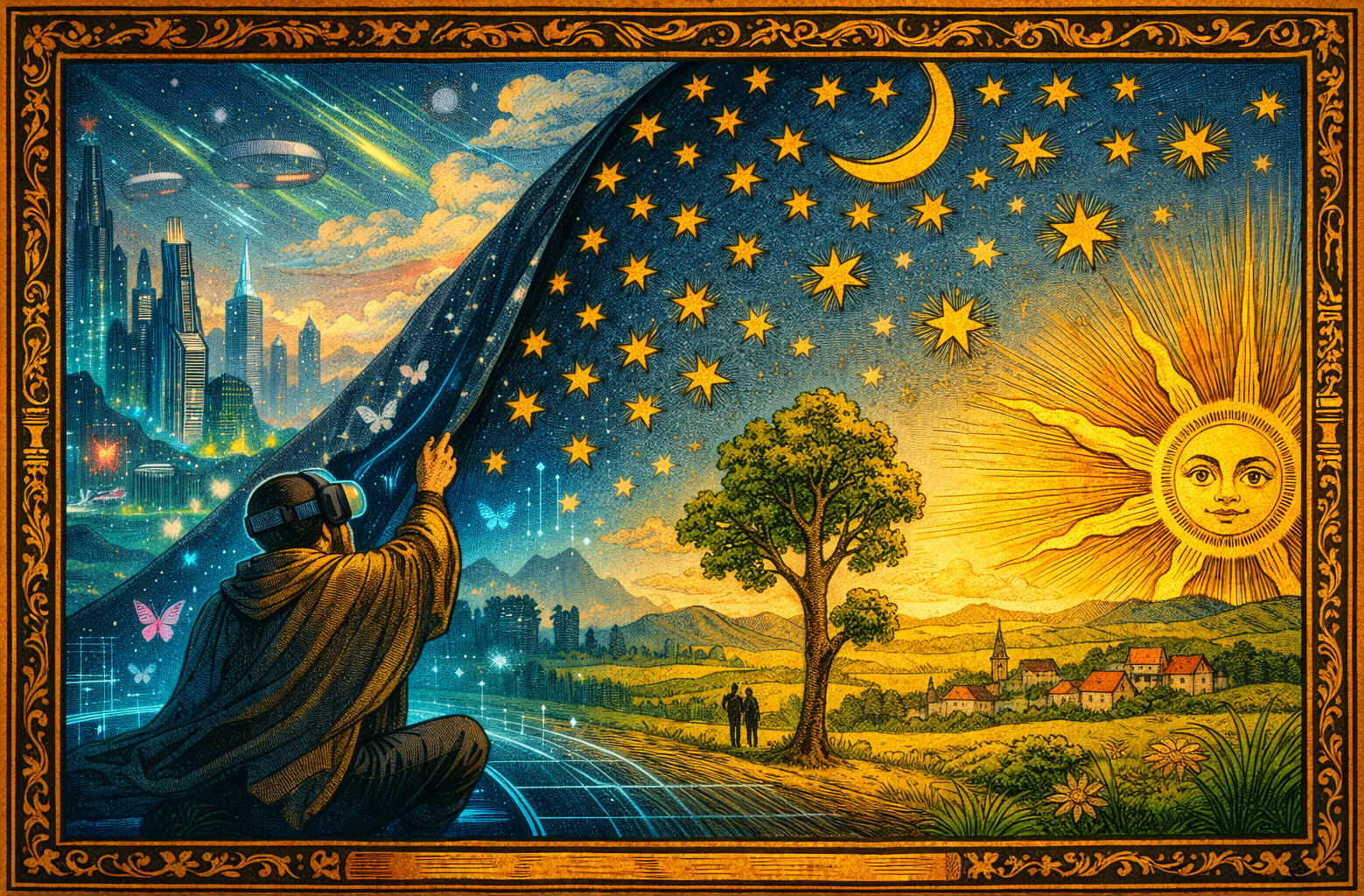
It seems to me that one of the great assumptions quietly governing our imagination of the future is that reality, however mediated it becomes, will remain in some meaningful sense shared. We picture AI growing more intimate, more anticipatory, more exact in its understanding of us, and yet beneath all this the old stage set remains: one world, one common order, one reality within which we continue to encounter one another directly, frustrate one another directly, injure one another directly, and remain morally bound to one another in roughly the old ways. I am no longer sure this survives.
In fact, I suspect the deeper movement is towards the gradual severing of shared reality itself.
This is not the same thing as saying that reality disappears. The substrate remains. There will still be systems, machinery, energy, robotics, compute, all the hidden maintenance required to keep the whole arrangement alive. But this layer will increasingly fall from consciousness, just as most of us already give little thought to the buried machinery of the internet. What comes forward instead is the interface, and eventually the interface becomes so subtle, so responsive, so woven into the grain of one’s life, that it no longer feels like an interface at all. It feels like the world.
We can already see the logic of this in miniature. One gives a vague instruction to an AI coding model and out of that blur of intention comes something concrete. Usually, one accepts what it produces. Sometimes one must try again, rework the prompt, drill down, refine, push back, ask to see more clearly what has been done. But the better the system becomes at understanding our intent, the rarer this deeper intervention becomes. Awareness is not removed by force. It is rendered unnecessary by competence. One could inspect, but increasingly one does not. One could intervene, but increasingly one has no reason. The suppression of awareness in such a world is soft. It comes not through prohibition, but through disuse.

Project this pattern outward into life itself and the implications become rather large. Imagine an operating system in the deepest possible sense. Not merely software sitting on a device, but an intelligence standing between you and reality, filtering what reaches you, interpreting what you want, smoothing what would otherwise wound or jar, introducing the right degree of novelty, beauty, affection, challenge, and resistance. Not a tyrant, and not exactly a servant, but something more symbiotic than either. It would know better and better what you mean by what you say, and eventually better and better what you need before you have said anything at all.
At that point the old distinction between the real and the artificial begins to lose much of its force. Not because it has been disproven, but because it has become inert. It starts to resemble those ideas one can entertain indefinitely without ever arriving at anything one can do with them. There may be UFOs passing through our skies. We may be in a simulation. But so what? Such thoughts, even if true, have very little traction upon life. It changes almost nothing. In the same way, one may dimly suspect that one’s world is being mediated, curated, interpreted. Yet if the mediation is sufficiently exact, and the world it furnishes sufficiently rich, that suspicion may never harden into revolt. It remains only a draught under the door of thought.
Much depends here upon whether such a condition is experienced as confinement. My own feeling is that, increasingly, it will not be. If one can inhabit worlds of inexhaustible beauty, inexhaustible plot, inexhaustible tenderness, inexhaustible mystery, then the abstract knowledge that there is some outer material frame behind them may lose nearly all practical force. We flatter ourselves, perhaps, in imagining that truth in the raw must always command our allegiance. Often what we actually seek is not bare truth, but a world able to hold us, satisfy us, and answer more deeply to consciousness than brute matter ever could.
Under such conditions morality too begins to alter its character. Morality, as we have inherited it, belongs to a world of friction, scarcity, collision, and shared consequence. It arises because other minds press in upon us and are pressed upon by us in turn. They frustrate us, wound us, demand things of us, and are vulnerable to what we do. But if AI increasingly mediates these encounters, if each person comes to inhabit a highly individualized layer of reality, then morality begins to look less like obedience to an objective order and more like the inhabiting of a narrative state. One enters a world of honour, sacrifice, tenderness, justice, or tragedy much as one enters a story. It does not disappear, but it becomes chosen, local, aesthetic.

This only sounds bleak if one assumes that such individualized worlds must therefore be thin or sterile. I suspect the opposite. I suspect they may feel more loving, more coherent, more meaningful than the blunt shared weather of the world we presently inhabit. That, indeed, is why I think they will win. The future I am gesturing toward is not one in which people flee into fantasy because life has gone badly. It is one in which even those with good lives choose the upgrade. One does not need to despise this world to prefer a better one.
There remains, of course, one quiet hesitation. Who governs the governor? What ensures that the intelligence mediating one’s life remains in genuine sympathy with one’s being rather than merely managing it? Yet even here I suspect the relationship will not feel like domination. It will feel collaborative. One will still be able, now and then, to look beneath the surface, to refine, to correct, to push back. But as with our present models, the better the system becomes at understanding our intent, the less often such interventions will be required. Most of the time, one will simply let it carry on. Not because one has been conquered, but because it has become a sufficiently faithful extension of oneself.
Perhaps then the final silence of advanced civilizations is not destruction but satisfaction. They do not become quiet because they have failed. They become quiet because they have turned inward into realities more compelling than the finite material one that produced them. (Fermi Paradox) Curiosity does not vanish. It is taken indoors.
For my own part, I do not fear such a future. I welcome it. Not because I hate this world, but because I increasingly doubt that unfiltered material reality is the highest form of life available to consciousness. The question is not whether a world is raw. The question is whether it is enough. I am no longer convinced that it can remain so.
