

Condemned to Freedom
“Freedom is what you do with what’s been done to you.” – Jean-Paul Sartre
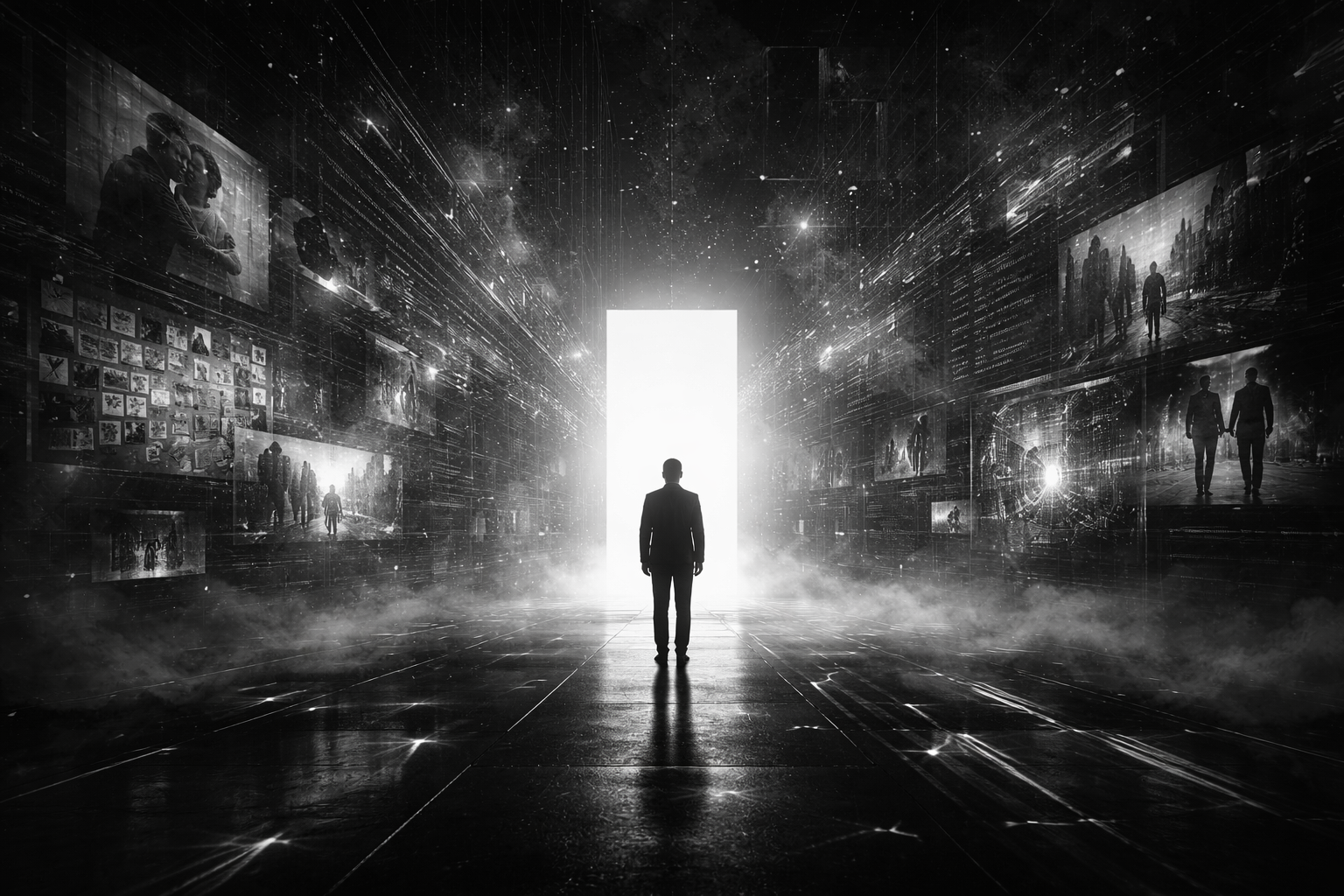
In a world of simulated realities and ever more immersive virtual spaces, freedom is no longer a metaphor. It has become a design problem and, more quietly, a psychological pressure point. We imagine complete freedom - the ability to revisit the past and correct our mistakes, to author every detail of our experience, to inhabit whatever persona we choose - as an intoxicating gift. But beneath that thrill lies a deeper question: what happens to the psyche when nothing binds, when no choice must be stayed with for long?
There is a strain of conservative thought that treats toil and resistance as moral goods in themselves, as though hardship were the foundation of character. It often drifts into a kind of ritualized suffering - a wallow-in-the-mud ethos justified as virtue. That misses something important. Difficulty for its own sake is not meaningful, and work does not automatically confer depth. But neither does freedom without commitment. If all challenge is optional, if every choice can be reversed without remainder, the texture that makes life feel lived begins to thin.
When I imagine a world in which you can re-enter any moment of your past, replaying it with infinite permutations - choosing differently, speaking differently, being differently - the first sensation isn’t dread. It’s fascination. There is a genuine fantasy here: the idea that our lives are drafts of a text we could edit forever. Given the chance, who wouldn’t want to smooth a few rough edges in their personal narrative?
And taken on its own, there is nothing pathological about this. We already inhabit consequence-free spaces all the time: imagination, rehearsal, fantasy, play. These are psychologically useful precisely because they are reversible. They allow excess, experimentation, and risk without cost. A sandbox is not a problem. It becomes a problem only when it is mistaken for a place where meaning itself should arise.
Trouble emerges when freedom is paired with the absence of stakes. If every choice can be undone immediately, if no path closes another even temporarily, something in the structure of experience begins to fail. The question is no longer “What should I do?” but “Why should I do anything at all?” Choice proliferates, but action loses weight.
In the non-virtual world, identity has gravity because it is shaped by relatively stable, interlocking factors. Your job, your body, your habits, your social network, your history - these things don’t change easily. They bind you to particular consequences over time. Make all of this fully malleable and identity becomes difficult to locate. Would you recreate something resembling your present self inside a virtual environment, or would the self become endlessly revisable, never required to settle long enough to cohere?
This is where the language of games becomes useful, understood in a broad sense. When we talk about games, we tend to think of consoles and PCs, but almost every human activity fits the pattern: relationships, travel, craft, aesthetic creation, even most forms of work. What matters is not difficulty for its own sake, but the presence of stakes within a frame. A game becomes engaging when a decision commits you, when consequences unfold even if they are not permanent in any ultimate sense.
If you are inhabiting a narrative world and you choose poorly, the world answers back. Characters respond. Paths close. The story darkens or collapses. You can always exit, reload, or restart, but while you remain inside the frame, the choice binds. That binding is enough. Consequences do not need to be irreversible to matter. They need only be inescapable for the duration of the story.
This distinction matters. The psyche does not require permanence so much as commitment. It needs decisions to stay decided long enough to shape perception, effort, and care. Freedom without stakes produces endless possibility. Freedom with stakes produces action.
For minds that crave feedback and forward momentum - something I know well - meaning emerges not from unlimited choice, but from visible progress within a structure that resists you just enough. A challenge must respond. It must register that effort has altered the field. Without that responsiveness, boredom sets in quickly, followed by disengagement. You are not oppressed by the world; you simply drift above it.
This is why god-mode play is briefly amusing and then empty. When nothing answers back, nothing matters. The pleasure of control gives way to thinness. Not despair, exactly, but a loss of grip.
Fantasies of virtual freedom often miss this distinction. They imagine a world without irreversible stakes and assume meaning will follow automatically. But meaning does not arise from freedom alone. It arises from entering a frame and staying inside it long enough for choices to matter.

Now imagine a near future in which each of us is accompanied by a private AI assistant: always present, predictive, and attentive. It orders necessities before we notice the lack, filters information, manages schedules, nudges decisions, and gradually shapes our environment in ways that feel frictionless (we will no doubt all have this in a few years). Scaled far enough, this assistance no longer supports life; it curates it.
In a fully virtualized setting, such a system would not merely respond to needs. It would monitor psychological states and adjust the world accordingly, smoothing disruptions, redirecting attention, and introducing challenge only when safe. At first glance, this looks benign. Even caring.
But the risk is not that the AI removes difficulty. It is that it removes stakes. A system that updates rescues us from commitment, that keeps every path open and every loss provisional, prevents the formation of narrative weight. We remain perpetually free, but never fully inside anything.
The danger here is not madness or collapse. It is something quieter. A hovering. A life lived half-outside itself, always able to withdraw, always one step removed from consequence. The self becomes a curator of experience rather than a participant in a story.
Perhaps the challenge of future worlds is not how to maximize freedom, but how to design frames that invite commitment without coercion. Worlds that allow exit, but reward staying. Worlds where choices bind long enough to matter, even if they are not eternal.
Freedom, in this sense, is not the absence of limits. It is the willingness to enter constraints temporarily and take them seriously. Too much friction and life becomes oppressive; too little and it dissolves into drift.
The deeper problem of freedom may not be how to escape consequence, but how to remain inside a choice once it has been made - long enough for it to shape us, cost us something, and give weight to what follows.
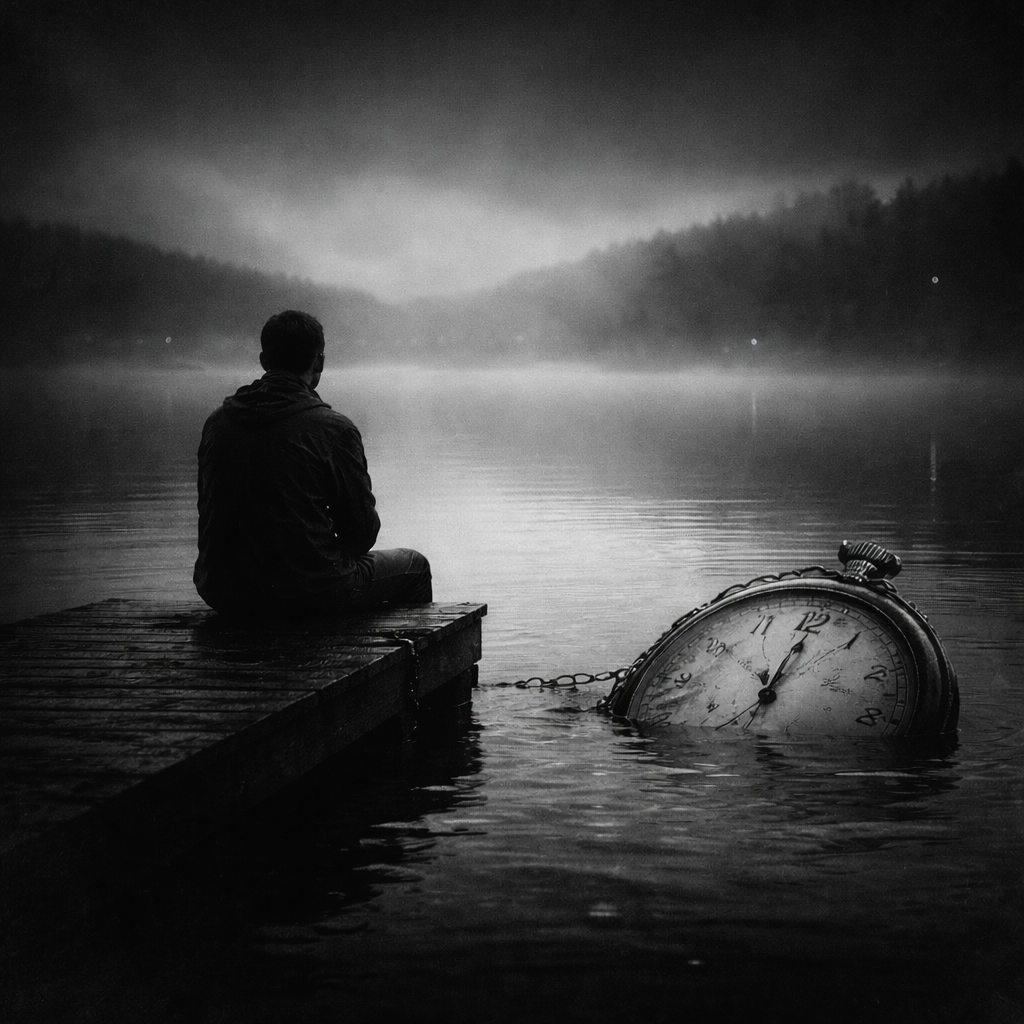
I’m into AI music creation atm, so I thought I would create a song based on this article using Suno.com.
